Open a compensation spreadsheet and you may see grades, bands, midpoints, range spreads, and rows of salaries with no obvious connection between them. The sheet gets easier to read once you understand that every number hangs from the same basic frame: jobs go into grades, grades get ranges, and employees get placed within those ranges.
A company can price every job one at a time. Plenty of small companies do that for their first fifty hires. Each offer may look reasonable on its own. Put all those offers next to each other, though, and the logic starts to wobble.
Sooner or later, someone has to explain why two software engineers with the same title and performance are paid $14,000 apart. If the company negotiated every offer in isolation, it has a pile of individual decisions and no consistent answer.
A salary structure gives every role a home. It groups jobs of similar value into the same pay range, then gives you a way to make decisions inside that range based on experience, performance, and position relative to market. You can explain what the company pays, how it pays, and why.
Start with pay grades
A pay grade, sometimes called a band, is a group of jobs worth roughly the same amount. A Senior Accountant, a Marketing Manager, and an HR Business Partner might all sit in one grade because their market rates and internal value are close enough that separate ranges would add noise.
Each grade gets one pay range with one minimum, one midpoint, and one maximum. Every job in the grade uses that range. You give up some precision in exchange for consistency and fewer arguments over small differences.
That trade is deliberate. Giving the Senior Accountant, Marketing Manager, and HR Business Partner separate ranges might suggest a level of precision the market data and internal job differences don't support. One shared range makes the company's judgment visible and keeps small distinctions from running the system.
The number of grades is a design choice. A small company might use five or six. A big company can have twenty-plus. More grades give you more granularity and more maintenance. Fewer grades put more jobs together. The right number depends on the variety of jobs in the company and how much separation you want between a junior employee and a senior one.
Set the three anchor points
Every pay range needs three numbers. Grade numbers aren't standardized across companies, so one firm's Grade 7 isn't another's. Say Company A has a Grade 7 that looks like this:
- Minimum: $90,000. This is the bottom of the range, roughly what you would pay a developing performer who is still learning the job. In a healthy structure, it sits near the market rate for someone who isn't yet fully competent in the role.
- Midpoint: $120,000. This is the middle of the range and its most important number. The midpoint usually represents the market target for a fully competent performer, someone who does the job well and consistently without hand-holding. When comp professionals say an employee is paid at the company's market target, they mean the midpoint.
- Maximum: $150,000. This is the top of the range, where a strong, tenured performer can sit. It also acts as a ceiling. Once an employee reaches the maximum, a promotion or range adjustment has to come before another big raise.
Everything in the structure is defined relative to the midpoint. You calculate the minimum and maximum from it, so start there.
Give employees room to grow
Range spread, also called range width, is the percentage distance from minimum to maximum. It tells you how much room an employee has to grow within one grade before reaching the ceiling.
For Grade 7, the calculation is:
($150,000 − $90,000) / $90,000 = 66.7%
The maximum is about 67% above the minimum. You can describe that as a 67% spread, or say the maximum is 1.67× the minimum.
Range spread usually widens as grades rise. As a rough guide:
- Entry-level grades often use a 30-40% spread. The role itself has less performance variation. A great junior analyst isn't doing a wildly different job from an okay junior analyst.
- Mid-level grades often use 40-60%.
- Senior and executive grades can use 80% or even 100%+. The difference between a decent VP and a star VP can be enormous, and the range needs room for both.
A flat 50% spread at every grade can overpay mediocre junior employees while senior stars reach the maximum and leave. Wider spreads at higher grades help the structure keep working past its first two years.
The spread has to match the grade because it controls how long employees can grow in place. Too little room at the top pushes your best senior employees against the ceiling. Too much room in an entry-level grade lets pay stretch well beyond the differences in the work.
Build the ladder with midpoint progression
Stack the grades and their midpoints rise by a percentage at each step. That increase is called midpoint progression.
Suppose the midpoints are $100k, $115k, $132k, and $152k. That is roughly a 15% progression, with each midpoint sitting about 15% above the one below it.
The step gives a promotion financial weight. If Grade 8's midpoint were only 3% above Grade 7's, a promotion would barely move pay and nobody would want one. A 50% step would create huge jumps and make the grades feel too far apart to form a ladder.
Midpoint progression commonly runs 10% to 20% for individual-contributor and mid-level grades. Between senior and executive grades it runs higher, often 20% to 35%, because those jobs can be categorically different.
Your progression shapes the career ladder. Tight progressions create many small steps, which suit long careers within one function. Wide progressions create fewer, larger jumps, which suit lean, flat organizations.
You can see the organization in those steps. A company with many levels needs smaller moves between them. A flatter company needs enough distance between grades for each move to carry meaning.
Let adjacent grades overlap
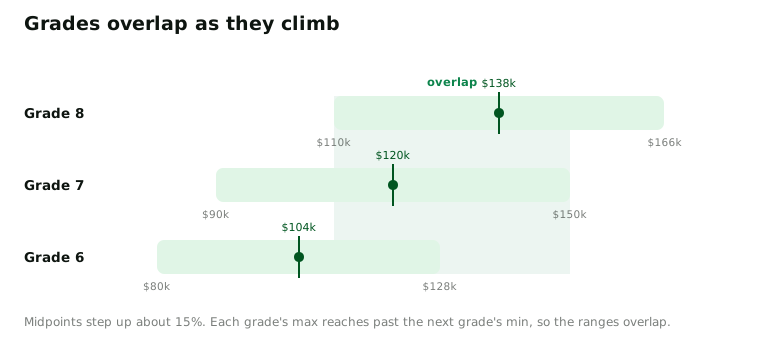
If Grade 7 has a $150k maximum and Grade 8 has a $110k minimum, an employee in the lower grade can earn more than an employee in the higher grade. The ranges were designed to allow it.
Grade overlap is the amount by which one grade's range extends into the next. In this example, the grades share the $40,000 from $110k through $150k. That is a large part of Grade 7's $60,000 range.
The overlap accounts for two practical facts. A strong, experienced employee in a lower grade can provide more value than a new employee still learning the grade above. The company also needs room to give a raise without forcing a promotion.
Remove the overlap and managers have to promote great performers to keep raising their pay. Some of those employees haven't grown into the next job, so a pay problem produces title inflation.
Overlap gives the structure a release valve. A tenured Grade 7 specialist can earn $148k while a new Grade 8 manager earns $112k, and both can sit in the right place. When the Grade 7 specialist is ready for promotion, they move into the meat of Grade 8's range. The pay story still makes sense.
Use the structure to make decisions
A salary structure gives you three things that are hard to get from separately negotiated salaries.
First, it makes pay decisions consistent. Two employees in the same grade with the same experience and performance should land in similar places because the company applies the same range and placement logic to both.
Second, it makes those decisions defensible. When a manager asks why their employee earns $118k while the employee at the next desk earns $126k, you can point to each employee's position in the range, compa-ratio, performance, and time in role.
A compa-ratio is pay divided by midpoint, expressed as a percentage:
$118k / $120k = 98%
It is one of the most useful numbers in compensation, and the structure gives it meaning. A later post in this series works through compa-ratio and its companion, range penetration, in full.
Third, the structure makes pay governable. You can see which grades are drifting above market, where employees are crowded at the maximum, and where a range adjustment may be due. A visible system gives you something you can manage.
Those signals matter across the company. One salary can look fine by itself while the full grade is drifting. The structure lets you see the pattern before another round of individual decisions makes it harder to correct.
Build a first structure
If your small business has no salary structure, start by sorting the jobs into a handful of broad grades. Five is plenty. Find a market midpoint for each grade using a salary survey, a benchmark subscription, or a credible free source.
Set the minimum at roughly 80% of midpoint and the maximum at roughly 120%. That creates a 50% spread. Adjust from there, with wider spreads for the top grades. Space the midpoints about 15% apart.
You now have a salary structure. The first version will need work. The ranges may be too tight. The overlaps may be larger than you intended. You may revisit the midpoint progression more than once. It can still do its job because you have written down the ranges and the logic behind them.
A useful structure is consistent, defensible, and open to improvement. It forces the company to decide what it believes about pay, then gives managers and employees a common way to understand the answer.