Most incentive plans go wrong long before anyone calculates a payout:
- The company picks measures employees can't influence.
- It promises a payout without checking whether it can afford one.
- It loads so much weight on one number that people chase that number at the expense of everything else.
A workable plan answers a few basic questions before the year starts:
- What results are you paying for?
- How will you measure them?
- What happens when performance falls short, or runs ahead of plan?
- And can the company afford the answer?
But first, let's clear something up...
Incentive or bonus? Not the same thing
Most people use "bonus" and "incentive" interchangeably. Comp professionals do it too, because "bonus" is shorter and everyone knows roughly what you mean. They describe two different things, though, and the difference shapes how you design a plan.
An incentive is variable cash tied to results you define in advance. It runs on a formula: hit these metrics, earn this payout. Its whole job is to incent. That is, to push people toward a specific outcome they can see coming and work toward, like a sales number or a productivity target.
A bonus, strictly speaking, is discretionary. Leadership looks back at the year (or after a particularly big win or recognition-worthy achievement) and decides someone earned extra cash for a job well done. There's no formula the employee could have run in advance. ("Bonus" also gets stretched to cover sign-on, retention, and referral awards, which are their own animals.)
Today, we're talking incentives -- the formula-driven kind.
Incentives pay for results
Base pay reflects the market value of a role and the employee's capability in it. It's steady, and employees can count on it. You work X hours, you get X pay, etc.
An incentive is the variable part, which is why they're referred to by comp professionals as "variable pay." They're tied to results you define up front.
I want to reiterate that: they're tied to results you define up front.
If a senior engineer already earns a premium salary for the scope of the job, which includes performing highly technical work and mentoring junior engineers, paying extra for "showing technical leadership" pays twice for the same thing, and it leaves the employee guessing about what earned the money.
Incentives should be used to reward outcomes the employee can influence and that move the business forward during the year. They should not be used to reward employees for performing duties that are an established expectation of the job.
An incentive is also different from equity. It pays cash this year for this year's performance. Equity is longer-term compensation and needs its own conversation.
Start with the target
Every incentive plan starts with a target. The target is what an employee earns when performance lands right where you expected, expressed as a percentage of base salary. An employee earning $120,000 with a 15% target has $18,000 on the line at full performance.
Targets usually climb with level, because senior people carry more responsibility for business results and put more pay at risk. A junior analyst might sit at 8-10%. A manager might be at 15%. A director at 25% or 30%. A CEO's target could be 100% or more.
The target also drives the employee's pay mix. Pay mix is the split of a person's target compensation between fixed base pay and variable pay, and, where they apply, long-term incentives. The variable share tends to grow with level. A bigger target moves that mix, but pay mix is the whole fixed-to-variable split, not the incentive percentage on its own.
The mix has to fit the role. Give a director a 10% target and you pay them like an individual contributor, with little financial stake in business outcomes. Give an analyst a 40% target and you've tied their rent to company results they can't move. Neither sends a signal that matches the job.
Choose measures employees can follow
Most plans blend company, team, and individual performance. Company measures like revenue, EBITDA, or operating income tie payouts to business results and help fund the pool. Team measures point people at shared goals. Individual measures reward personal contribution.
A mid-level employee might run on a plan weighted 40% company, 30% team, 30% individual. An executive usually leans harder toward company results. An individual contributor usually leans toward team or individual measures.
Stop at three or four measures. Each one you add makes all the others carry less weight. Employees are likely to focus on one or two anyway. Adding more just adds noise and gives the formula more ways to surprise you. You want the incentive to drive performance, but you also want to be able to budget for the outcomes.
Every employee also needs a line of sight to their measures. A junior engineer can't move company EBITDA. Leadership may care about that number, but to the engineer the payout will feel random. Match the measure to the scope of the role.
Critically, you should use measures you can score. "Culture contribution" may be real, valuable, and shouldn't be overlooked, but until you have a rubric that defines it, a manager is making a judgment and calling it a metric.
Build the threshold-target-maximum curve
Each measure needs three points: a threshold, a target, and a maximum. Threshold is the minimum performance that earns anything. A good starting point is paying 80% of the target payout. Target is full performance and pays 100%. Maximum is the cap, above which more performance doesn't pay more. Depending on budgets and forecasting, this could be as high as 200%, but usually sits closer to 150%.
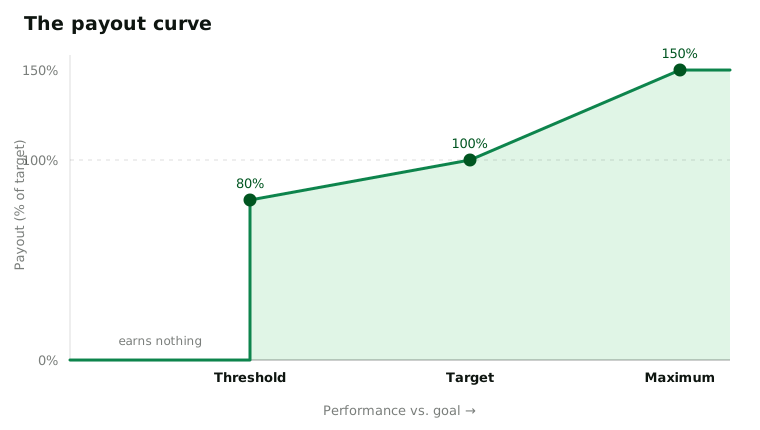
These three points control what the plan costs. Skipping the threshold causes you to pay regardless of outcome, and you wind up paying even after a bad miss. Leave the maximum open and a breakout year can produce a payout you can't cover.
Then decide how the plan funds. In most workable plans, company performance sets how much of the incentive pool is available. Hit the operating income target and the pool funds at 100%. Miss it and the pool might fund at 70%, and you prorate every individual payout against the smaller number.
Funding is what keeps an incentive from turning into a promise you can't keep.
Walk through the math
Take a marketing manager earning $110,000 with a 15% target. Her incentive at target is $16,500. Her plan is weighted 40% company revenue, 30% team campaign performance, 30% individual goals.
Overall profitability beat plan, so the company funds the pool at 110%. Treat that 1.10 as a company affordability check on its own, separate from the revenue measure inside the formula. Start there: $16,500 × 1.10 = $18,150.
Now run each measure through its own threshold-target-maximum curve. The results are payout factors: 120% on company revenue (weighted 40%), 90% on team campaign performance (weighted 30%), 100% on individual goals (weighted 30%).
Performance factor = (0.40 × 1.20) + (0.30 × 0.90) + (0.30 × 1.00) = 0.48 + 0.27 + 0.30 = 1.05.
Payout = $110,000 × 15% × 1.10 (funding) × 1.05 (performance) = $19,057.50. That's roughly 116% of the $16,500 target.
You can read the story off the number. The company did well, the team came up a little short, the individual hit her goals.
Decide how much discretion belongs in the plan
The discretionary bonus comes back here. It's leadership's call at year-end, with no published formula and nothing the employee could calculate in advance. A formulaic incentive is the opposite: you document the metrics, weights, and payout curve, and the math produces the answer.
Discretionary awards are easy to set up and cause plenty of grief at payout time. Employees can't connect their work to what they receive, so it starts to feel like whatever the boss decided (or whoever the boss likes more), which gives no one a reason to change what they do during the year. Discretionary awards that aren't carefully monitored can lead to adverse consequences for the business.
Keep a small discretionary piece for the unusual contribution that the metrics may have missed. Cap it, and be open with the employees that it exists. You can be honest about the design without publishing the amounts.
A formulaic incentive front-loads the work. You have to define the metrics, set the thresholds, and commit to the rules. In return, employees understand the plan, and you have a credible way to focus effort, and to justify the payouts when an employee voices a concern.
Watch for the predictable failures
Managers run the risk of sandbagging when they set soft, easy-to-achieve targets, post inflated results, and collect the maximum. It is critical to challenge the targets, and tie them to the real business plan.
The funding gap usually hides until payout time. The formula says pay $2 million, but the company has $1.2 million. A separate funding check forces that conversation while you're still designing the plan, not after, and saves you from some difficult conversations later.
Measures outside an employee's control create their own failure. If the employee can't control the outcome, the payout feels random. They'll take the money, for sure. But it won't point their work at anything the company needs.
Put the priorities in writing
Employees read the measures, the weights, and the payout curve, and they hear exactly what you'll pay for.
If you weight revenue growth and ignore margin, they'll chase revenue at any cost, margin be damned.
But if you weight time, scope, and quality evenly, you've asked them to hold all three.
A good incentive plan is short enough to explain, tied to results employees can influence, and funded at a level the company can afford. Write the rules down before the year starts. When payout time comes, the employee and the manager should be able to look at the same calculation and agree on how you got there.