P50 gets called the market average often enough that the mistake can pass through a meeting without anyone stopping it.
The 50th percentile is the median. Half the employers in the survey pay less and half pay more. The average, properly called the mean, comes from a different calculation. Surveys often report the mean too, but comp professionals lean on the median, because a few unusually high or low observations can pull the mean around.
Percentiles hold up better. They show how pay is distributed across the market without allowing one giant payer to skew the result. When a compensation professional says "P50," they mean the middle of the market by rank. That distinction may sound small, but companies build entire pay strategies on it.
Read a percentile as a rank
Line up every employer's pay for a job from lowest to highest. The 25th percentile is higher than 25% of the observations and lower than the rest. The 50th percentile, also called the median, splits the list in half. The 75th percentile is higher than three-quarters of the market. At the 90th percentile, only the top ten percent of employers pay more.
Survey data usually labels these cuts P25, P50, P75, and P90. Some surveys also show P10 at the bottom. Together, the cuts tell you where the middle sits and how far the market stretches around it.
A narrow spread between P25 and P75 shows that employers agree fairly closely on pay for the job. A wide spread shows much more variation. You often see that with a new role, inconsistent titles, or a few hyperscalers paying out of band for scarce talent.
The percentile only locates the pay figure within a dataset. It carries no verdict about the quality of the pay. P75 may fit one company's strategy, while P25 may fit another's. You supply the judgment when you decide where your company should compete.
Name the market
"We pay above market" sounds decisive and leaves the important questions unanswered.
Which market? You could mean above the median of a national all-industry survey. You could mean above P75 in a technology-specific cut for your metro. Or you could mean above P90 in a niche survey of fifty fintech competitors. Each answer can be defensible, and each produces a very different dollar figure for the same role.
A useful market statement names the surveys or sources, the relevant cut, including industry, geography, and company size, and the percentile. It also says how often the company refreshes the data. Until you set those terms, "above market" expresses a mood.
Start by choosing whose pay you will compare against, which surveys or sources you will use, and how often you will update it. Then the target percentile has something concrete to describe.
Pick a position: lead, match, or lag
Once you have defined the market, choose a target percentile. That choice gives your compensation philosophy a number.
- Match: Pay at the median, or P50. You sit in the middle of the pack, so other parts of the employment offer have to settle a close contest for talent.
- Lead: Pay above the median, often at P60, P65, or P75. You spend more cash to gain speed and access to scarce talent.
- Lag: Pay below the median, often from P25 to P40. You rely on other parts of the opportunity to make up the cash gap.
Lead and lag work like a dial. P55 is a slight lead. P75 is a strong one. P30 is a clear lag. A percentile states the degree more precisely than a slogan can.
Companies usually lead where talent is scarce and the cost of an empty seat is high. A staff engineer role left open for six months costs far more than the extra $15k required to pay at P65. Leading can also speed up recruiting and make counteroffers less dangerous. It raises payroll, though, and every market movement ratchets up the company's cost base.
A company may lag because cash pay is one part of the opportunity it offers. Mission, ownership, equity that might become valuable, flexibility, and the chance to do work you can't do anywhere else can all carry weight. A research lab, a scrappy nonprofit, or a founder-led startup with real upside can lag on cash and still hire the employees it wants.
That approach needs a deliberate decision. If the company has ignored its survey data for three years, its lag says nothing about strategy. It says the company stopped checking.
A position you don't maintain becomes a lower one
Picking a position is a commitment, not a setting you choose once. The market keeps moving whether or not you touch your midpoints. Hold your grades still for a year and the market climbs past them, so your position slides down on its own.
The number you chose has a shelf life. Lead at P60 today, skip a refresh, and you may sit at P50 a year later without changing a thing. Match at P50 now, leave it alone, and next year you lag, guaranteed. The market did the moving. Your structure stayed where it was.
The higher you aim, the more discipline the choice demands. A lead stays a lead only if you age your survey data, revisit your midpoints on a set schedule, and move them before the gap opens. Choose P60 and forget it, and you have bought a P50 with extra steps. Decide how you will maintain a position when you decide the position itself.
Set different positions where the work calls for them
One percentile rarely serves every job family and level equally well. You can vary the position across the company when the talent markets differ.
Lead for the roles where you compete hardest. That may include a difficult-to-hire engineering specialty, a revenue-producing sales team, or a thin layer of senior leadership the company can't afford to lose. Administrative, early-career, and other roles with a deep local supply may sit at match or a mild lag without causing the same hiring pressure.
A healthy company could price engineering at P65 and operations at P45. The difference makes sense when those jobs draw from different talent markets.
Level can change the target too. Some companies lead at the top, where the talent pool is small and a bad hire can cause severe damage. They lag at the bottom while investing in training and expecting internal promotion. Other companies reverse the pattern. They pay strongly at entry level to attract the best early-career talent and give senior roles more equity.
Both approaches can work. A single P50 target doesn't cover a 500-person company with six job families.
Price a developer at P60
Suppose you are pricing a mid-level software developer in your metro. The survey reports these annualized base-salary figures:
- P25: $118,000
- P50: $135,000
- P75: $158,000
- P90: $182,000
Your philosophy for engineering is to lead lightly. You want enough pay to recruit quickly while keeping payroll under control, so you choose P60.
The survey doesn't publish P60, which means you need an estimate. P60 falls between P50 and P75. Because 60 is about 40% of the way from 50 to 75, linear interpolation gives you this calculation:
$135,000 + 0.40 × ($158,000 − $135,000) = $135,000 + $9,200, or about $144,200.
The survey didn't hand you that figure. It is a linear-interpolation estimate based on the published cuts.
The $144,200 becomes your target pay, which serves as the midpoint of the range for the role. You might set the range at 80% to 120% of target. That creates a band from about $115,400 to $173,000.
Look at where those endpoints land. The bottom sits just under P25. The top falls between P75 and P90, and closer to P90 because $173,000 is well above the $158,000 P75. The band gives you enough room to hire and retain employees while keeping internal equity believable.
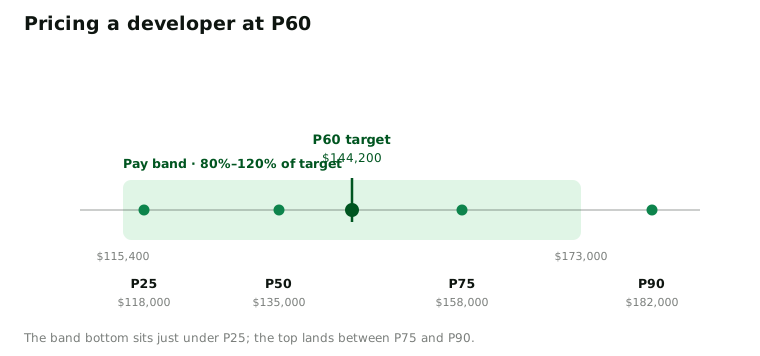
If someone asks why the target is $144,200 instead of $135,000, you have an answer: the company chose to lead the market slightly for engineering, and the interpolated P60 estimate shows what that choice costs this year.
Write the position down
Percentiles connect market data to pay strategy. Use the definitions correctly: P50 is the median, while the mean is the average. Define the market before you choose a target, then pick the position on purpose.
Lead where scarce talent or an expensive vacancy justifies the cost. Match where the middle supports the company's needs. Lag where the rest of the opportunity can carry more of the load.
The finished statement should let you explain why the company pays what it pays, both in dollars and in plain sentences. That is the useful part of a percentile. It turns a survey column into a decision you can defend.