Most merit cycles start with a fixed pool of money and more requests than the pool can cover.
Finance sets the budget. HR and compensation build the matrix and the rules. Managers recommend increases. Then compensation reviews the numbers, asks questions, and brings the total back to budget.
That process can look bureaucratic. It also gives the company a consistent way to decide who gets a raise and how much. Without one, the employee with the loudest manager often gets the money. Across-the-board increases create a different problem: they reward tenure over contribution, and they slowly weaken the pay structure.
The merit cycle works when the budget, matrix, guardrails, and calendar work together. Each part answers a different question.
What the merit cycle covers
The merit cycle, sometimes called the annual compensation review, is typically a once-a-year process in which a company reviews employee pay and decides who gets a raise and how much. Most companies run it alongside performance reviews, often in the first or second quarter.
Finance sets the budget months before the increases take effect. HR and compensation build the tools, including the matrix, worksheets, and manager guidance. Managers submit their recommendations. Compensation reviews and calibrates them, and pushes back when the numbers don't fit. Leadership signs off. Payroll applies the increases on a specific date.
That sequence matters. A performance rating provides one input to the decision. Where the employee's pay sits relative to midpoint provides another. The budget limits the total, and the guardrails keep similar cases within a reasonable distance of one another.
Start with the merit budget
Every cycle starts with the merit increase pool, a percentage of eligible base payroll that the company sets aside for raises.
Eligibility depends on the company's rules. New hires still in their first cycle may be excluded. Employees already at the range maximum may be excluded too, along with others covered by the rules. If a company has $10 million in base salaries and a 4% merit budget, it has $400,000 to spend, assuming all $10 million is eligible. If part of that payroll is ineligible, the pool shrinks with it.
Finance forecasting, market data, and leadership's willingness to spend all shape the percentage. In a typical year, budgets land in the 3% to 4% range. They tend to rise when inflation runs hot and fall when the economy softens.
The pool stays fixed once the company sets it. If managers recommend increases equal to 5% of payroll against a 3% budget, compensation has to bring the recommendations back to 3%. Overspending the pool is a quick way for a compensation team to lose credibility with finance.
The work of the cycle is allocating that constrained pool fairly and putting each dollar where it will do the most good.
Use the merit matrix
A merit matrix is a grid that recommends an increase based on two inputs: the employee's performance rating and where their pay sits relative to the midpoint, measured by compa-ratio.
Compa-ratio sounds more complicated than it is. Divide the employee's salary by the midpoint of the pay range and express the result as a percentage. An employee at midpoint has a 100% compa-ratio. An employee at 85% sits below midpoint. One at 115% sits above it.
The matrix puts performance ratings down one side and compa-ratio buckets across the top: below, near, and above midpoint. Each cell contains a recommended increase percentage.
Some companies build that second axis on position in the range instead. They split range penetration into quartiles, the bottom 0-25%, then 25-50%, 50-75%, and the top 75-100%, and slot each employee into one. Compa-ratio and range penetration measure different things: compa-ratio is distance from midpoint, penetration is how far a salary sits from the minimum toward the maximum. Either can drive the matrix. This article uses compa-ratio, but the logic works the same way with quartiles.
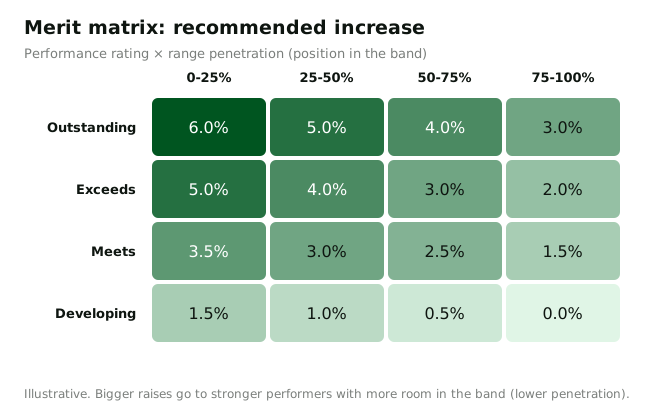
Consider two high performers. One sits below midpoint, while the other already earns more than it. The first gets the larger recommended increase. That employee has room to grow toward midpoint, so a larger raise moves the salary up without pushing it past the top of the range. The employee above midpoint receives a smaller increase that keeps the salary progressing and respects how far above midpoint it already sits.
This is how the matrix makes the budget work harder. It directs more money to strong performers who have more structural room to move. Give everyone the same percentage and you lose that targeting.
Walk one employee through the matrix
Take an analyst earning $70,000. The midpoint for her role is $80,000, so her compa-ratio is 87.5%, which puts her below midpoint. Her performance rating is "exceeds expectations."
The company's matrix gives "exceeds" performers a 5% increase when they sit below midpoint, 3.5% near it, and 2% above it. Every company sets its own numbers and calibrates them to its budget. The shape is the point.
The analyst lands in the below-midpoint, exceeds cell and receives 5%. On a $70,000 salary, that is a $3,500 raise, bringing her to $73,500. Her new compa-ratio is about 91.9%. One cycle doesn't fully close her gap to midpoint. The increase recognizes her performance and moves her toward midpoint.
Now take a peer in the same role with the same rating who earns $92,000. His compa-ratio is 115%, so he lands in the above-midpoint, exceeds cell and receives 2%. That produces a $1,840 raise. He earns an increase for strong performance, while the smaller percentage reflects his salary above midpoint.
The rating and cycle are the same. The dollars differ because the employees sit at different points relative to midpoint.
Keep each base-pay action in its own bucket
Employees and managers often use "raise" to cover several base-pay actions. Merit increases, market adjustments, internal-equity adjustments, and promotion increases come from different budgets and follow different logic.
A merit increase is the annual performance-driven increase covered here. It comes from the merit pool and runs through the matrix.
A market adjustment corrects external competitiveness. When market data shows that an employee earns less than the labor market pays for the role, the company can move the salary up to close the gap. The company can make this adjustment at any time, using a separate budget. Market data triggers the action, independent of the employee's performance rating and the annual cycle.
An internal-equity adjustment fixes an unjustified pay gap between comparable employees inside the company. Two employees may hold the same role and deliver the same performance, yet one earns less without a defensible reason. Internal comparison triggers this adjustment. Market adjustments look outward at labor-market data. Internal-equity adjustments look across the company's own employees.
A promotion increase applies when an employee moves into a higher-level role. The change in job triggers it, and the increase should reflect the added scope. It often produces a larger increase than merit and doesn't depend on the annual calendar.
Combining these actions distorts the merit matrix. Ratings start influencing market corrections and equity fixes. Promotions consume the merit pool. Then the high-performing analyst who sits below midpoint gets 2% because the company spent the available money fixing a gap it should have caught six months earlier.
Keep the budgets and logic separate. That keeps the calculations honest.
Give managers room inside guardrails
Managers know details the matrix can't capture. They know who may get poached and who stepped up during a rough quarter. They also advocate with different levels of skill and persistence. Without guardrails, two employees with the same rating and similar compa-ratios can receive different raises because one manager argued harder.
A useful approach gives the manager a range around the matrix recommendation. If a cell recommends 4%, the manager may choose from 3% to 5% with a written justification. Anything outside that band requires compensation approval. The manager can apply judgment, and compensation can review the outliers.
Managers need training to use that room well. A smart, well-meaning manager may give the largest raises to the longest-serving employees because tenure feels fair. Another may give everyone the same percentage to avoid a difficult conversation. Both choices defeat the purpose of the matrix. Managers need the framework and the language to explain it. Otherwise, the spreadsheet will sit unused.
Check the recommendations before approval
Fairness in a merit cycle requires a check after managers submit their recommendations. Compensation should confirm that higher ratings received larger increases and that recommendations followed the matrix across compa-ratio buckets.
Then break down the results by manager. Flag managers whose average increases differ sharply from peers with the same performance distribution. Break the results down by demographic group as well, and investigate patterns that performance or compa-ratio can't explain. These checks make the cycle defensible.
The common failures are easy to recognize:
- Across-the-board raises. Everyone gets 3%. The company spends the same amount on an employee who excels and one who coasts, and tells the high performer that the difference didn't matter.
- Tenure rewarded as contribution. The longest-serving employee gets the largest increase based on years of service. A cycle that calls tenure "merit" gives strong younger performers a reason to leave.
- Compa-ratio ignored. A manager focuses on the rating and overlooks compa-ratio. Giving the same increase to high performers at 115% and 85% pushes one farther above midpoint while leaving the other below it.
- The pool spent before calibration. Recommendations exceed the budget, so leadership overspends or cuts every recommendation equally. The equal cut penalizes correctly sized recommendations to cover the oversized ones. Build calibration into the cycle. Allocating the pool is the work.
Make the cycle do its job
The merit cycle allocates a fixed budget. The matrix directs the money using performance and compa-ratio. Guardrails leave managers room for judgment while keeping comparable decisions close enough to defend.
If you are new to compensation, learn the logic of the matrix before you memorize your company's percentages. A high performer below midpoint receives more than a high performer above it because the first employee has more room to move within the pay structure.
Once you understand that relationship, the rest of the cycle becomes easier to follow. You can see what the budget allows, why two employees with the same rating may receive different increases, and what a flat percentage would erase.